Your dog doesn’t care that your living room doubles as your office and your gym. They just want to run, sniff, and learn stuff. Good news: you can raise a well-mannered, happy pup even in a studio apartment.
You just need smart training, tight routines, and a few creative hacks. Let’s make your small space do big things.
Affiliate Disclosure:
This post may contain affiliate links. If you click on these links and make a purchase, I may earn a small commission at no additional cost to you. Thank you for supporting this blog!
Set the Ground Rules on Day One

Your dog learns your house rules fast—good or bad. Decide where your dog sleeps, where they can lounge, and what’s off-limits.
Then stick to it like it’s law. Keep it simple:
- Pick 3–5 core cues: sit, down, stay, leave it, place. Nail those first.
- Use the same word every time. “Off” means off. Not “hey get down please.”
- Reward the moment they do the thing.
Don’t wait. Timing matters.
“Place” Is the Apartment MVP
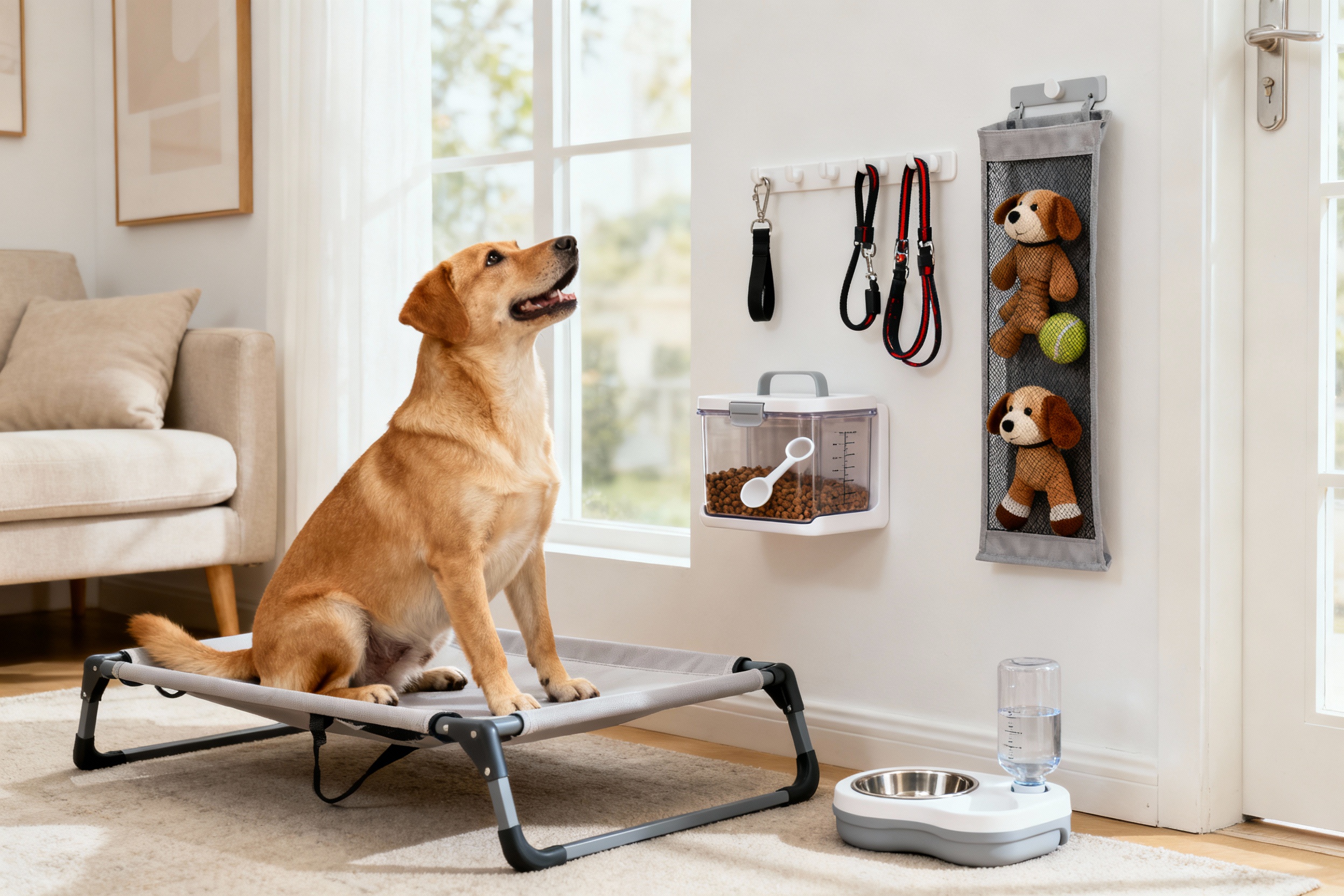
Teach your dog to go to a bed or mat on cue. It creates instant calm in tight quarters.
Start with short sessions—5 treats for 5 seconds on the bed—then build duration and add distractions. Place stops door-dashing, counter-surfing, and Zoom-meeting chaos.
🧠 Want a smarter, easier way to train your dog?
👉 Try Brain Training For Dogs – a proven method to stop bad behavior by boosting your dog’s intelligence.
Burn Energy Without a Backyard
No yard? No problem. You can tire out a dog’s brain and body in a hallway.
- Sniff work: Scatter kibble on a towel, in a snuffle mat, or across the room.
The nose tires the mind fast.
- Stair or hallway fetch: Short throws, soft toys. Stop while your dog still wants more.
- Flirt pole: A cat toy for dogs. Quick bursts, then a “drop it,” then rest.
- Training circuits: Sit–down–spin–touch–place. 2–3 minutes equals a mini workout.
Brain Games Beat Zoomies
Puzzle feeders, frozen Kongs, and hide-and-seek with treats turn your dog into Sherlock Bones.
Start easy so they win quickly. Then level up. Mental work equals calmer dog in 10 minutes flat.

Make Leash Manners Apartment-Friendly
Tight hallways and elevator drama can wreck leash training. You can fix it with micro-sessions. Try this 5-minute drill:
- Clip the leash inside your apartment.
- Take 3 steps; if the leash stays loose, mark and treat.
If it tightens, stop and wait. No pulling = forward movement, pulling = statue.
- Repeat to the door, then the hall, then the elevator.
Elevator Etiquette That Saves Your Sanity
Teach “sit and watch me” as the doors open. Block with your body if you need space.
If the elevator’s crowded, skip it and wait for the next one. Advocate for your dog; you’re the bouncer.
Quiet Dog, Happy Neighbors
Barking in thin-walled apartments gets awkward fast. Instead of shushing, train.
- Preempt the bark: When you hear the trigger (footsteps, elevator ding), cue “place” and reward calm.
- Teach “quiet”: Mark and treat the split second your dog stops barking. Name it “quiet.” Grow that silence from 1 second to 10.
- Cover the windows: Frosted film or curtains remove visual triggers.
Less to bark at.
- White noise: Fans or noise machines help during work calls or naps.
Separation Training in a Small Space
Your dog hears you everywhere. Build independence anyway.
- Start with short exits. Keys jingle, treat on the bed, step out for 30 seconds.
Return, yawn-level calm. Repeat.
- Use stuffed Kongs only for alone time. The Kong predicts chill vibes.
- Log durations.
Increase slowly. If your dog whines, you went too fast. IMO, slower equals faster.

Potty Training Without a Backyard
Apartment potty training needs precision.
No guessing, no “maybe later.” You run the schedule. Dial in your routine:
- Take your dog to the same spot every time. Same smell, faster success.
- Morning, after meals, after play, before bed—non-negotiable.
- Use a cue word like “go potty.” Reward immediately after they finish.
Indoor Options That Actually Work
If you need a backup plan:
- Grass pads: Real or synthetic. Place on a balcony or a bathroom corner.
- Set boundaries: Leash your dog to the pad during training to avoid “potty tourism.”
- Fade it out: Move the pad closer to the door over weeks, then outside.
FYI, consistency is everything here.
Teach Calm as a Skill
Your dog won’t magically “settle.” You must train it. Yes, like you train sit.
- Capture calm: When your dog flops down on their own, quietly drop a treat at their paws. Do this 10 times a day.
- Chill cue: Pair a word like “settle” with a long exhale and slow petting on the chest.
Keep it boring.
- Duration builds: 10 seconds of calm becomes 30, then 2 minutes. Add mild distractions slowly.
Chew Therapy
Satisfy the jaw to save your furniture. Rotate safe chews—rubber toys, dental chews, bully sticks (supervise). Chewing lowers arousal and buys you email time.
Space-Savvy Gear That Pulls Weight
You don’t need an agility course in your living room.
A few smart tools cover a lot.
- Foldable crates or soft-sided pens: Create a cozy “den” that disappears when company comes.
- Snuffle mat and puzzle toys: Small footprint, huge mental workout.
- Mat/bed with grip: Your “place” target. Non-slip saves training sessions.
- Hands-free leash: Perfect for hallway practice and coffee runs.
Storage Hacks
Use a hanging door organizer for leashes, treats, poop bags. Keep everything by the exit. Fast setups = fewer training excuses.
Social Skills Without the Dog Park Chaos
Not every apartment dog loves crowds (relatable).
You can still build confidence.
- Field trips: Short visits to quiet sidewalks or pet-friendly shops. Treat for calm scanning, not for pulling you to strangers.
- Greeting rules: Ask for a sit, then “go say hi.” Keep it quick. Your dog returns for a treat.
Autopilot manners, unlocked.
- Opt-out is okay: If your dog stiffens or avoids, skip the greeting. Consent matters, even for dogs.
FAQ
How much exercise does an apartment dog actually need?
Breed and age matter, but aim for two 15–30 minute walks plus 2–3 short training or sniff sessions daily. On rainy days, add a puzzle toy or two.
Quality beats quantity; focused nose work tires them out faster than zombie laps.
What if my dog barks when I leave?
Start with ultra-short departures and build up. Pair exits with a high-value chew they only get when alone. Film with your phone to track progress.
If panic kicks in within minutes, consult a trainer who specializes in separation anxiety—this stuff responds best to a plan.
Can I train a large dog in a small apartment?
Absolutely. Big dogs often lounge more than small ones. Focus on impulse control (place, leave it, settle), structured walks, and mental work.
Space doesn’t limit training; inconsistency does, IMO.
How do I stop door-dashing in a hallway building?
Install a visual boundary, like a runner rug. Practice sit and wait as you open the door one inch at a time. If your dog breaks, close it and reset.
Reward releases only. Add neighbors or deliveries as later-level distractions.
Are pee pads a good long-term solution?
They work for small breeds, seniors, or when outdoor access isn’t reliable, but they can blur lines for some dogs. If you plan to transition outside, use a grass pad, not a fabric-like pad.
Fade location gradually until the “bathroom” lives outdoors.
What treats should I use without overfeeding?
Use tiny pieces—pea-sized or smaller. Mix high-value (chicken, cheese) with regular kibble. Subtract training treats from meal portions.
Your vet will thank you, and your dog won’t notice the difference.
Bottom Line
Small space doesn’t equal small standards. Teach a few powerhouse cues, tire the brain daily, and set routines you can actually keep. Your apartment becomes a training dojo, not a chaos cave.
Keep sessions short, celebrate tiny wins, and remember: a tired, trained dog is the best roommate you’ll ever have.
Ready to Go Deeper?
Want a smarter, more effective way to train your dog—and eliminate bad behaviors like chewing, barking, or jumping?
🎓 Try Brain Training For Dogs – a science-based program designed to boost your dog’s intelligence and create a well-behaved, calm companion.
🟢 100% online
🟢 Easy to follow
🟢 Works for all breeds & ages👉 Click here to start transforming your dog today!





Leave a Reply